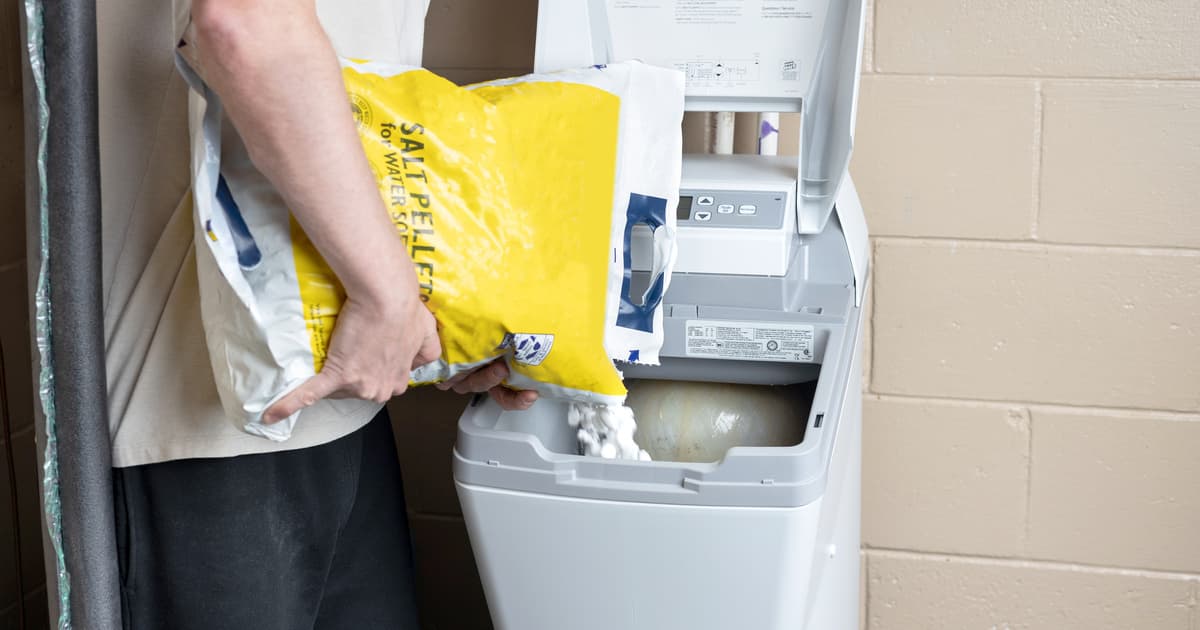
A traditional ion-exchange water softener removes calcium and magnesium from your water and dumps a salt-brine waste stream to the sewer. A salt-free water conditioner (TAC) does not remove hardness; it converts it to a non-sticking crystal. For most South Florida homes above 10 gpg of hardness, a softener is still the documented winner. Conditioners shine in condos and HOAs that ban brine.
Not sure which technology fits your South Florida house?
Free in-home hardness test and recommendation
A SoFlo Water Pros technician measures hardness in grains per gallon, checks your drain access and HOA rules, and lays out the softener-vs-conditioner trade-off in plain English. No high-pressure pitch.
What a True Ion-Exchange Water Softener Does
A traditional water softener is a tall fiberglass tank filled with small plastic beads called cation exchange resin. As hard water flows through the resin bed, calcium and magnesium ions stick to the beads and equal amounts of sodium (or potassium) ions release into the water. The chemistry is one-for-one, predictable, and backed by more than 70 years of NSF/ANSI Standard 44 testing. Calcium and magnesium are physically gone from the water leaving the tank.
Once the resin is loaded with calcium, the system runs a regeneration cycle. It pulls a concentrated salt solution (brine) from a separate tank through the resin, flushes the calcium and magnesium out to the drain, and rinses the resin clean. The regeneration cycle is what generates the waste stream that South Florida condos and some HOAs care about. Modern demand-initiated regeneration (DIR) softeners only regenerate when actual water usage triggers it, which keeps the brine volume low.
Softened water feels different. Soap lathers. Hair conditioner rinses out faster. Glass shower doors stop spotting. The white-crystalline scale that builds on the inside of your water heater, your aerators, and your shower heads stops forming. All of those benefits come from one mechanism: the calcium is not in the water anymore. Read more on the water softener service page for a deeper look at sizing and configuration.
What a Salt-Free Water Conditioner (TAC) Does
A salt-free water conditioner using template-assisted crystallization (TAC) media works on a different principle entirely. The TAC media sits in a tank that water flows through (no backwash, no brine, no electrical controller in most models). As water passes the media, calcium and magnesium ions are encouraged to form microscopic crystals while still suspended in the water. The crystals are too small to feel and too stable to stick to pipes, shower glass, or heating elements.
The hardness is still in the water when it reaches your tap. A TAC-conditioned glass of water will still test the same gpg as the feed. The difference is mechanical. The hardness is in crystal form rather than dissolved ion form, so the white crusty scale does not deposit on hot surfaces. Independent testing under the German DVGW W512 protocol and academic studies (most notably from Arizona State University) report scale-prevention efficacy in the 80 to 99 percent range depending on water chemistry, flow rate, and feed hardness.
Notice what TAC does not do. It does not soften water. It does not give you the slick-soap feel. It does not stop hardness staining on glass shower doors (because the calcium is still there). It does not extend the life of soap, shampoo, or dishwasher detergent. It is a scale-prevention device, not a softening device. Calling it a softener (which many salt-free companies do) is technically inaccurate.
South Florida Hardness by Utility
The right technology for your home depends heavily on how hard your water actually is, which varies more across South Florida than most homeowners assume. The big three utilities all draw from the Biscayne Aquifer, but each runs different treatment trains and publishes its own annual numbers.
- Miami-Dade Water and Sewer Department. The MDWASD water quality reports consistently show finished water in the moderately hard to hard range. Translated from the reported mg/L into grains per gallon, most service areas land around 8 to 14 gpg.
- Broward County Water and Wastewater Services. The Broward water quality reports show a similar range, often a touch higher in inland service areas than coastal ones. Typical readings fall between 9 and 15 gpg.
- Palm Beach County Water Utilities. The Palm Beach County quality reports report a broader spread across the multiple plants the county operates. Many service areas come in slightly softer than Miami-Dade or Broward, often 7 to 12 gpg.
For homeowners on private wells in unincorporated western Broward or the Redland, hardness can run much higher (often 15 to 25 gpg) and is best confirmed with an in-home test rather than estimated. Our deeper guide on South Florida hard water by zip code breaks down the utility-by-utility numbers in detail.
How Each Technology Handles South Florida Numbers
The USGS classifies anything above 10.5 gpg as "very hard." Most South Florida households sit right at that threshold or above it, which has direct implications for which technology actually solves the problem.
For ion-exchange softening, efficacy is essentially independent of feed hardness up to the resin's design capacity. A correctly sized softener handles 25 gpg feed just as cleanly as 8 gpg feed. The only variable is how often it regenerates, and a properly sized system regenerates roughly every 7 to 14 days for an average household. Performance is documented under NSF/ANSI Standard 44 at the unit level.
For TAC conditioning, efficacy is sensitive to feed hardness, flow rate, and water temperature. The Arizona State University study from 2010 and follow-up work by the Water Quality Research Foundation documented strong scale prevention up to roughly 25 gpg of hardness under controlled conditions. In actual South Florida homes above 15 gpg, real-world results are more variable. TAC systems also lose performance as flow rate climbs above their rated specification, which means peak-demand sizing matters more than for softeners.
For a typical Miami-Dade or Broward home at 10 to 14 gpg, either technology can produce a noticeable improvement in scale deposition on aerators, shower heads, and water heater elements. The decision usually hinges on other factors: drain access, HOA or condo rules, salt restrictions, and how much the homeowner values the slick-soap feel of true softened water. Our companion guide on South Florida aerator clogging walks through the day-to-day symptoms that tell you which problem you actually have.
Regen Water, Brine Disposal, and HOA/Condo Rules
This is where the technology decision gets practical in South Florida. Salt-based softeners discharge brine to the drain during regeneration. The volume is small per cycle (a typical residential regen uses 25 to 75 gallons) but it is salty water, and that has real-world consequences in three specific situations.
- Condos and HOAs that explicitly ban brine. Several South Florida condo associations and gated communities, especially in Aventura, Sunny Isles, and the Brickell corridor, prohibit ion-exchange softeners outright in their CCRs because the brine adds to building sewer load. For these properties, TAC is the only option that addresses scale at all.
- Septic systems. Households in unincorporated Broward, the Redland, and parts of Palm Beach County that run on septic instead of sewer can install softeners, but the brine adds salinity to the drain field. Florida code allows it; some installers route the discharge to a separate dry well or design for lower-frequency regeneration. TAC eliminates the question entirely.
- Sodium-restricted households. The added sodium in softened water (roughly 7 mg of sodium per grain of hardness removed per liter) is usually trivial dietary, but some households with strict medical sodium restrictions or salt-free cooking preferences choose potassium chloride salt or skip softening altogether. Potassium chloride costs more per pound but performs the same chemistry. Reverse osmosis at the kitchen tap removes any residual sodium from drinking water and is the standard pairing.
For most single-family homes in Miami-Dade, Broward, and Palm Beach on city sewer with no HOA salt restriction, neither the sodium nor the brine volume is a real obstacle. Our brine tank service page covers ongoing maintenance, and the salt delivery service page explains the recurring side of softener ownership.
Hardness is local. Pick the right technology for your specific home.
A SoFlo Water Pros technician runs a hardness test in your kitchen, looks at your drain layout, reads your HOA covenants, and recommends the smallest right-sized system. Same-week appointment windows across Miami-Dade, Broward, and Palm Beach.
Cooling Towers, Tankless Heaters, and ASHRAE 188 Considerations
For commercial properties and larger residential complexes, scale-prevention decisions intersect with ASHRAE Standard 188, the building water system risk management standard that addresses Legionella. Cooling towers, large-volume hot water systems, and recirculating loops are all sensitive to scale, and scale tends to harbor biofilm that supports Legionella growth.
For these larger applications, traditional softening is the documented standard because it removes hardness completely and produces predictable downstream water chemistry. TAC media has seen growing commercial adoption for cooling-tower makeup water, but the engineering literature still treats softening as the default for high-criticality systems. For a typical South Florida single-family home, ASHRAE 188 is not directly relevant, but the underlying logic (scale plus biofilm equals bacterial growth) applies in miniature to your water heater, your shower head, and the splay in your aerators.
For homes with a tankless water heater, scale becomes especially important because tankless heat exchangers run high temperatures in a small volume and scale up quickly on hard water. Most tankless manufacturers either require or strongly recommend softening (or at least scale prevention) upstream to maintain warranty. Our walkthrough of whole-house water filter install in South Florida covers how the softener integrates with the rest of the system.
Independent Certifications That Actually Matter
The water-treatment industry has accumulated more certifications than most homeowners need to learn, but a handful are worth recognizing.
- NSF/ANSI Standard 44. Covers cation exchange water softeners. Verifies the resin chemistry, the hardness removal claim, and the structural integrity of the tank. Salt-based softeners from major brands are routinely certified.
- NSF/ANSI Standard 372. Lead-free certification for components in contact with drinking water. Both softeners and conditioners should carry this; it is now a federal requirement.
- DVGW W512 (Germany). The most-cited third-party protocol for testing salt-free conditioner scale prevention. A TAC system that publishes a DVGW W512 result has quantified its efficacy under controlled conditions. Most do not, which says something about the broader market.
- WQA Gold Seal. The Water Quality Association tests against the same NSF standards but is a separate accreditation. Either is acceptable; both is better.
- IAPMO Listing. Plumbing-code listing required by most municipalities for any device installed on the residential supply line. Confirm this is in place before any permit-required install.
If a salt-free conditioner manufacturer cannot produce a DVGW W512 or equivalent third-party test result, treat the marketing claims with caution. The technology is real; some products implementing it are not.
Recommended Method: Match Your Hardness to Your Technology
Use the table below to pick the right starting point for your specific home. Confirm your actual hardness reading with an in-home test rather than utility averages.
| Your hardness reading | Your situation | Recommended technology |
|---|---|---|
| Under 3 gpg | Soft water, rare in South Florida | No softening needed. Consider carbon filtration only. |
| 3 to 7 gpg | Moderately hard, condo with brine restriction | Salt-free TAC conditioner with a documented DVGW result. |
| 7 to 10 gpg | Hard, single-family with drain access | Ion-exchange softener preferred. TAC acceptable if salt is restricted. |
| 10 to 15 gpg | Very hard, typical Miami-Dade/Broward | Ion-exchange softener strongly recommended. Pair with RO at kitchen. |
| Over 15 gpg | Extremely hard, typical well water | Ion-exchange softener is the only complete fix. TAC is not rated reliably at this level. |
Call a Professional If Any of These Apply
Choosing between softener and conditioner is a homeowner-grade decision. Several scenarios warrant pulling in a licensed installer before you order anything.
- You live in a condo or HOA-restricted community and have not read the salt/brine clause of your CCRs. The wrong technology here means a system that violates community rules and may have to be removed at your expense.
- You are on septic instead of sewer. The drain field design interacts with brine discharge in ways that vary by Florida county and require a permit conversation.
- Your water heater is a tankless unit, especially one under factory warranty. Most manufacturers require softening for hard water and TAC may not satisfy the warranty language.
- You have already installed one technology and want to know whether the symptoms you still see (spotting glass, stiff laundry, fast-fouling aerators) are the system or a separate issue.
- Your home runs on a private well in western Broward or the Redland with hardness above 15 gpg and any iron present. Iron fouls softener resin if not pre-filtered, and fouls TAC media even faster.
- You operate a vacation rental, short-term rental, or second home with long stagnation windows. Recurring biofilm changes the sizing math for either technology.
Any of those, give us a call and we will sort it out. Read more on the SoFlo Water Pros team page, browse our frequently asked questions, or check the cities we cover on the service area page.
Frequently Asked Questions
Is a salt-free water conditioner really as good as a softener?
For scale prevention only, a quality TAC conditioner can match a softener in the 80 to 99 percent range under controlled testing. For everything else (slick feel, soap performance, glass spotting, laundry texture), a softener wins because it physically removes calcium. Picking depends on which benefit matters most to your household and whether brine is allowed.
Does a softener add too much salt to drinking water?
Softeners add roughly 7 milligrams of sodium per liter for every grain of hardness removed. For a 10 gpg South Florida home, that is about 70 milligrams per liter, well under the EPA secondary guidance level of 60 milligrams per 8-ounce glass for restricted diets. Most households pair a softener with kitchen reverse osmosis, which removes the residual sodium from drinking water.
Can I install a softener in my condo if my HOA allows it?
Yes, if the HOA covenants and Florida plumbing code permit it. The constraint is usually drain access, not the technology itself. High-rise condos rarely have a brine-drain path that meets code, which is why TAC conditioners have become the default for condo retrofits in Miami Beach, Sunny Isles, and Brickell.
How long does each technology last in South Florida?
A properly sized ion-exchange softener lasts 12 to 15 years on average, with resin replacement around year 10 and valve service every 5 to 7 years. TAC media has a stated service life of about 3 to 5 years before the catalytic sites lose efficacy and the media has to be replaced. Total cost of ownership over 15 years usually lands within the same range across both technologies.
Will softened or conditioned water taste different?
Softened water tastes faintly different to some people because of the added sodium, especially at the bathroom sink where it is not usually filtered. TAC-conditioned water tastes identical to feed water because nothing has been removed or added. Pairing either system with reverse osmosis at the kitchen tap eliminates the question for drinking and cooking.
What about magnetic or electronic descalers?
Independent testing on magnetic and electronic descaler devices has been mixed at best. The Water Quality Research Foundation and academic studies have generally not been able to verify the scale-prevention claims marketed for these devices. Until a manufacturer publishes a DVGW W512 or equivalent third-party result, we recommend either traditional softening or a certified TAC system rather than magnetic descalers.
Pick the right technology the first time.
Free in-home water test for South Florida homeowners.
A certified SoFlo technician measures hardness, checks drain access, reads your HOA covenants if you have them, and recommends the smallest right-sized system. Call or book online.
Related reading
Related: South Florida hard water by zip code · South Florida aerator clogging · Whole-house water filter install in South Florida · All blog posts · All services · Water softeners · Whole-home filtration · Reverse osmosis · Water testing · Salt delivery · Brine tank service · City water · Well water · Service area · Savings calculator · FAQ · About · Home